An AI Math Map for MFE Students: You Already Know Most of It
An AI Math Map for MFE Students: You Already Know Most of It
The Day Before
Tomorrow afternoon I will give a talk in the UIUC MSFE Speaker Series.
Prof. Liming Feng, who directs the program, invited me.
The title is AI in Quantitative Finance: What MFEs Need to Know Now.
Near the end of the deck there is a slide called You Already Know the Math. It holds one small table:
| You learned | It is now called |
|---|---|
| Binomial, Condorcet | self-consistency voting |
| Logistic regression, MLE | fine-tuning, DPO, item response theory |
| Low-rank factorization | LoRA |
| Floating-point error | LLM non-determinism |
| Sequential testing | label-free drift alarms |
And one line under it:
AI did not replace mathematics. AI industrialized mathematics.
When I made that slide, I was thinking of the students on the other side of the Zoom screen.
Not only the ones at UIUC, though. This entry is for anyone studying for an MFE, or thinking about one.
Some have just arrived and are in their first semester of statistics, computing, and machine learning. Others have finished stochastic calculus and are starting to look for jobs.
Yet they open a paper on diffusion models, or a write-up on LoRA, and feel they have to start over.
They don't have to start over.
But not everything carries across, either.
I went through this myself.
From 2012 to 2016 I spent four years earning an MFE degree, part-time, alongside work.
Halfway through, in 2014, I took my first data science course on Coursera and started learning big data.
In 2018 I learned deep learning from Andrew Ng's Neural Networks and Deep Learning.
Stochastic calculus on one side, machine learning on the other. As I went, I noticed that much of the two rested on the same things underneath: covariance matrices, gradients, dynamic programming, Brownian motion. The names and the notation differed. The derivations were often the same.
When I later wrote Mathematics for AI, I wrote it for people learning machine learning. It is not a quant-finance textbook. But what I noticed in those years stayed with me.
So I drew two circles.
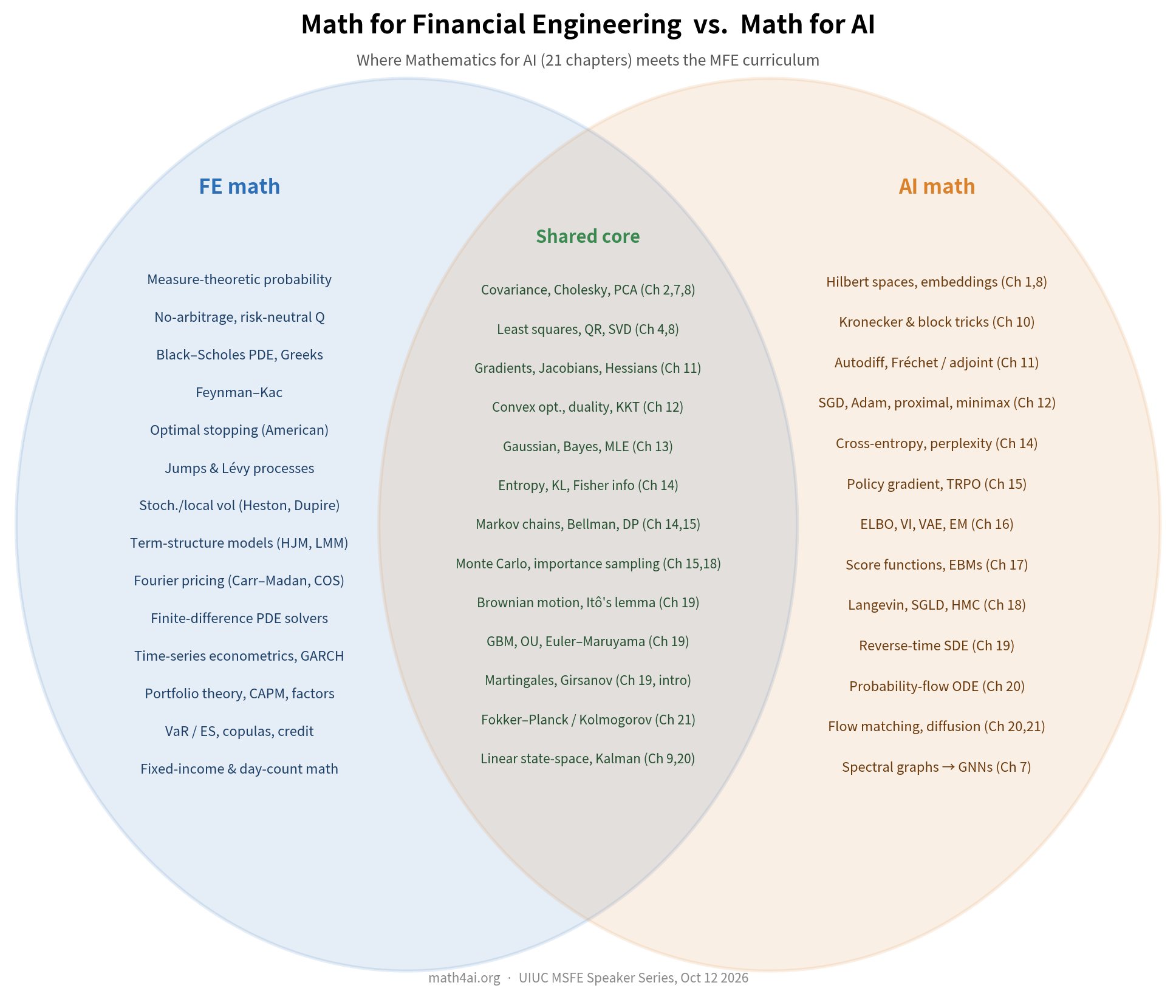
Financial engineering on the left, AI on the right.
The middle is larger than most people assume.
1. The Middle: Math Both Sides Use
Start with linear algebra.
A quant who needs correlated Brownian paths for Monte Carlo takes a Cholesky factor of the covariance matrix: $\mathbf{z} = L\boldsymbol{\epsilon}$.
A VAE draws its samples with the same factor.
PCA on the yield curve gives level, slope, and curvature. LoRA writes a weight update as the product of two thin matrices, $\Delta W = BA$, with rank $r$ far below $d$.
That is Chapters 2, 7, and 8 of the book.
Then calculus and optimization.
Greeks are derivatives. $\Delta$ is the first, $\Gamma$ the second, and delta-gamma VaR is a second-order Taylor expansion. Backpropagation is the chain rule.
A Markowitz portfolio is a quadratic program, solved with KKT conditions. Training a network uses the gradient descent from the same chapter.
Chapters 11 and 12.
Probability and information theory are Chapters 13 and 14: Gaussians, Bayes, maximum likelihood, KL divergence.
Dynamic programming is Chapter 15. Pricing an American option, you walk back from expiry, and at each node you compare exercising now with holding on. That comparison is the Bellman equation. Value iteration in reinforcement learning is the same equation.
Last, stochastic calculus, Chapters 19 through 21.
Brownian motion, Itô's lemma, geometric Brownian motion, Euler–Maruyama. MFE students know these well. The book's Ornstein–Uhlenbeck process is the Vasicek short-rate model under another name. The Fokker–Planck equation in Chapter 21 is the Kolmogorov forward equation, and Dupire's local-volatility formula comes out of it.
One bridge here deserves a few more lines.
In pricing, Girsanov's theorem swaps the drift $\mu$ for the risk-free rate $r$ and takes us from the real-world measure $\mathbb{P}$ to the risk-neutral $\mathbb{Q}$. That is why there is no $\mu$ in Black–Scholes.
A diffusion model generates an image by running its noising process backward. The backward SDE is
The extra drift term is the score, $\nabla \log p_t$. It comes from a change of measure too.
A student who can explain why $\mu$ is missing from Black–Scholes will get through Chapter 19 faster than most CS students.
By chapter:
| Math | Chapters | In FE | In AI |
|---|---|---|---|
| Covariance, Cholesky, spectral decomposition | 2, 7 | Correlated path simulation; repairing non-PD correlation matrices | VAE reparameterization; Gaussian processes |
| PCA, SVD, low rank | 7, 8, 9 | Yield-curve factors; statistical factor models | Embeddings, LoRA, compression |
| Least squares, QR, pseudoinverse | 4, 8 | Longstaff–Schwartz regression; curve fitting | Linear probes; ridge regression |
| Gradients, Jacobians, Hessians | 11 | Greeks; delta-gamma VaR | Backpropagation; second-order methods |
| Convex optimization, duality, KKT | 12 | Mean-variance portfolios; calibration | Training objectives; constrained optimization |
| Gaussian, Bayes, MLE | 13 | Lognormal prices; parameter estimation | Likelihoods and priors; diffusion noise |
| Entropy, KL, Fisher information | 14 | Minimum-entropy calibration; model risk | Cross-entropy loss; ELBO; natural gradient |
| Markov chains | 14, 15 | Rating migration matrices; regime switching | Token sampling; MCMC |
| Bellman, dynamic programming | 15 | American options; optimal execution | Value iteration; Q-learning; RLHF |
| Monte Carlo, importance sampling | 15, 18 | Path-dependent pricing; tail risk | Policy gradients; sampling |
| Brownian motion, Itô, GBM, OU | 19, 20 | Black–Scholes; Vasicek; path simulation | The forward noising process |
| Martingales, Girsanov (introductory) | 19 | Risk-neutral pricing | Reverse-time SDE |
| Fokker–Planck | 21 | Transition densities; Dupire | Density evolution; probability-flow ODE |
| Linear state space, Kalman | 9, 20 | Filtering latent factors | State-space sequence models |
2. The Right: AI Only
Many MFE programs already require machine learning; UIUC, for one, has FIN 553 in the first semester. But Chapters 16 through 18 — variational inference, score functions, Langevin sampling — still have no counterpart in most course lists.
They are making their way into banks anyway.
XVA desks compute thousands of sensitivities with AAD, adjoint algorithmic differentiation. AAD is reverse-mode autodiff, the section of Chapter 11 on Fréchet derivatives and adjoints.
Deep hedging trains a hedging strategy with stochastic gradient descent.
Stress testing needs many yield-curve and vol-surface scenarios, and some teams have started generating them with diffusion models.
Counterparties and supply chains form graphs. The math of graph neural networks starts from the spectral decomposition in Chapter 7.
Searching research notes and filings runs on embeddings and inner products.
On my team there is a quant-finance PhD, Andrey. Give him a mortgage portfolio and he won't start by running XGBoost, and he won't just stare at a prepayment S-curve. He works out the economic mechanism first. Then he uses ML to estimate borrower-level prepayment probabilities, feeds them into the cash-flow engine, discounts under consistent rate scenarios, computes OAS and risk sensitivities, stress-tests, and keeps monitoring after deployment.
The classical model stays in charge. ML adds a bounded correction.
Someone like that needs to know a fair amount from both circles.
3. The Left: FE Math the Book Leaves Out
The book is about the math under machine learning. It has little finance in it.
Black–Scholes appears once, as an example of geometric Brownian motion. Girsanov gets a note. The Kalman filter gets one sentence in the LDL section.
Most of the topics below do not appear at all. I searched the manuscript for each one before writing this list.
They are grouped roughly in the order you meet them in an MFE program.
A. Probability foundations
- Measure-theoretic probability: $\sigma$-algebras, filtrations as information, conditional expectation as projection
- Radon–Nikodym derivatives and equivalent measures (the book uses a change of measure but does not build one)
- Martingale theory in more depth: optional stopping, Doob's inequalities, the martingale representation theorem
- Stopping times and the strong Markov property
B. No-arbitrage pricing
- No-arbitrage and the Fundamental Theorems of Asset Pricing: existence and uniqueness of $\mathbb{Q}$, complete and incomplete markets
- Numéraires and change of numéraire: forward, swap, and annuity measures
- Binomial and trinomial trees (Cox–Ross–Rubinstein)
- The Black–Scholes–Merton PDE by replication; Greeks and hedging
- The Feynman–Kac formula
- Optimal stopping and free boundaries: American and Bermudan options
C. Processes beyond Brownian motion
- Poisson processes and jump-diffusions (Merton, Kou)
- Lévy processes (Variance Gamma, NIG, CGMY) and the Lévy–Khintchine formula
- Stochastic volatility (Heston, SABR) and local volatility (Dupire)
- Rough volatility and fractional Brownian motion
- Hawkes processes for clustered order flow
- Stochastic control and the HJB equation (the book stops at discrete MDPs and continuous-time Markov chains)
- Malliavin calculus
D. Rates, fixed income, credit
- Curve construction: bootstrapping, splines, multi-curve and OIS discounting
- Short-rate models: Vasicek, CIR, Hull–White (Vasicek is the book's OU process, but not the bond-pricing part)
- The HJM framework; LIBOR and SOFR market models
- Duration, convexity, key-rate DV01; day-count and compounding conventions
- Credit: the Merton structural model, intensity models, CDS pricing, CVA/XVA
- Copulas: Gaussian, $t$, Archimedean
E. Numerical methods for pricing
- Finite differences for pricing PDEs: explicit, implicit, Crank–Nicolson; stability; boundary conditions; tridiagonal solves
- Fourier pricing: Carr–Madan FFT, the COS method
- Monte Carlo variance reduction: antithetic and control variates, stratification, moment matching
- Quasi-Monte Carlo: Sobol sequences, the Brownian bridge
- Least-squares Monte Carlo (Longstaff–Schwartz)
- Pathwise and likelihood-ratio Greeks (the likelihood-ratio method is a close relative of the score function in Chapter 17)
- Root-finding and quadrature: Brent's method for implied vol, Gauss–Hermite quadrature
- Interpolating and arbitrage-free smoothing of vol surfaces (SVI and its variants)
F. Statistics and econometrics
- Time series: AR, MA, ARIMA, unit roots, cointegration
- Volatility models: ARCH, the GARCH family, realized volatility
- Hypothesis testing: $t$ and $F$ tests, Newey–West standard errors, multiple testing in backtests
- Heavy tails and extreme value theory: Student-$t$, GPD, peaks over threshold
- Covariance shrinkage and random-matrix cleaning: Ledoit–Wolf, Marchenko–Pastur
- Bootstrap resampling
G. Portfolio, risk, trading
- Mean-variance theory, the efficient frontier, CAPM, APT
- Factor models: Fama–French, Barra-style fundamental models
- Black–Litterman and robust portfolio optimization
- Risk measures: VaR, Expected Shortfall, coherence, VaR backtesting
- The Kelly criterion; utility functions (CRRA, CARA)
- Optimal execution and microstructure: Almgren–Chriss, Avellaneda–Stoikov, limit order books
It is a long list. A good part of it, though, can be built with tools from the book.
Each Crank–Nicolson step solves a tridiagonal system with the LU factorization from Chapter 5. Markowitz is the KKT conditions of Chapter 12 plus a covariance matrix. HJB is the Bellman equation of Chapter 15 with the time step taken to zero and Itô's lemma from Chapter 19 applied.
The tools are in the book. How they are used in finance is in the finance books: Shreve for A through C, Brigo–Mercurio for D, Glasserman for E, Tsay for F.
If I Were an MFE Student
MFE programs differ from school to school, but their core courses look much alike. I paired the common kinds of courses with chapters of the book.
| Common MFE course | Read alongside | Why |
|---|---|---|
| Statistics and econometrics for finance | 2, 7, 8, 13 | Covariance, PCA, maximum likelihood |
| Financial computing, numerical methods | 4, 5, 15 | Numerical rank, LU, dynamic programming |
| Machine learning in finance | 11, 12, 14, 15 | Backpropagation, optimization, cross-entropy, RL |
| Stochastic calculus, derivatives pricing | 19, 20, 21 | Itô's lemma, SDEs, Fokker–Planck |
| Optimization, portfolio management | 12 | Convexity, duality, KKT |
| Deep learning electives | 16, 17, 18 | Variational inference, score functions, Langevin |
A few notes.
Many numerical problems in pricing code turn out to be conditioning problems. Chapter 4, on numerical rank, is about exactly that.
Stochastic calculus is the course closest to the book. Read Chapters 19 to 21 alongside it. They will go quickly, and you will see the SDEs behind the Black–Scholes PDE from a second direction.
Chapters 16 to 18 are a step beyond most MFE course lists. In an interview, not many candidates can explain why a diffusion model works, and fewer can tie it back to Girsanov.
Closing
The two circles stand on the same math: linear algebra, probability, optimization, stochastic calculus.
They part over the questions they ask. Financial engineering prices and hedges under $\mathbb{Q}$. AI fits and samples from the distribution of the data.
The book covers the middle and the right. The list on the left is still learned one item at a time, in an MFE classroom.