Back in an MFE Classroom, Through a Screen
Back in an MFE Classroom, Through a Screen
Nine in the Morning
Nine a.m. in California. Eleven in Illinois.
When I opened Zoom, Prof. Liming Feng was already there. He directs the Master of Science in Financial Engineering (MSFE) program at the University of Illinois Urbana-Champaign.
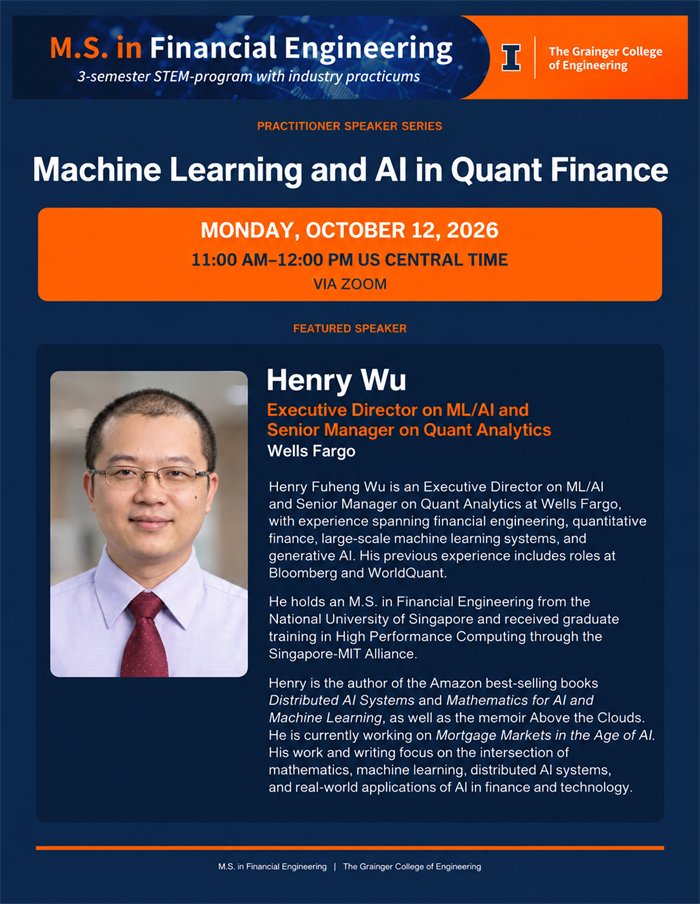
A few days earlier, the program had posted the announcement on its Practitioner Speaker Series page:
People trickled in.
My virtual background was the Golden Gate Bridge. Later, one of the students who asked a question had the same one.
Prof. Feng introduced me, and I put up the first slide.
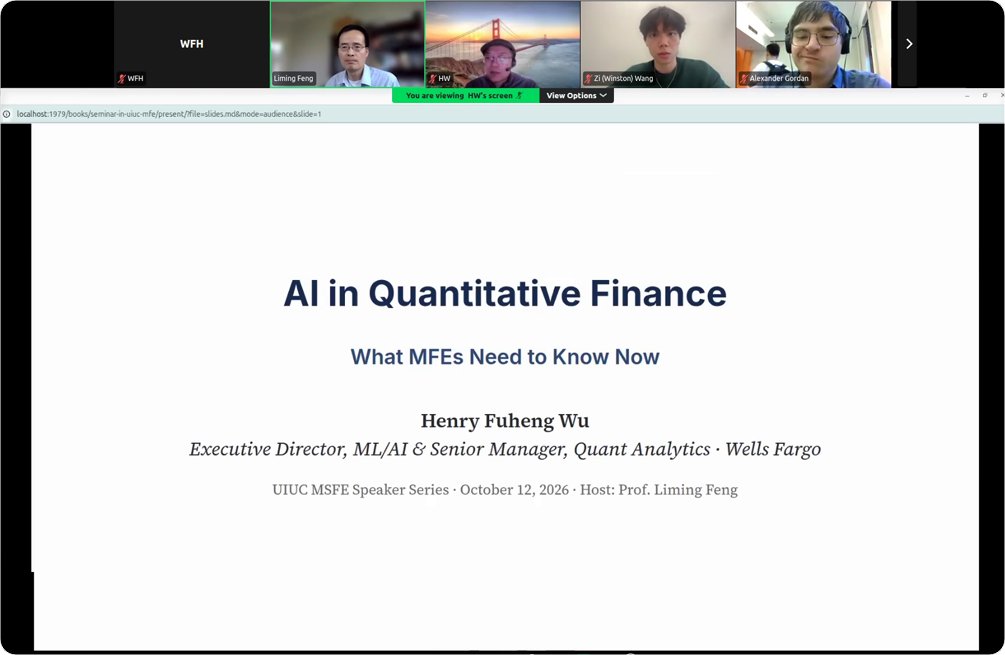
AI in Quantitative Finance: What MFEs Need to Know Now.
The second slide had four lines: convertible bond pricing at Bloomberg, Asia-Pacific trade execution at WorldQuant, generative AI at Google, Uber, and Oracle, and now ML and quant analytics at Wells Fargo.
And one sentence underneath:
The tools changed at every step. The questions a good quant asks did not.
I said it for them. I also said it for myself.
What They Were Worried About
I had a fair idea what the people on the other side of the screen were thinking.
In class, they are working through stochastic calculus and pricing theory. Outside class, the news says every week that AI can write code, read filings, and replace junior analysts.
Are the two years they're spending on all this already going stale?
I didn't answer that head-on. I started with a few systems that actually run inside banks.
Every example came back to the same point: AI hasn't knocked down the financial model. It has moved in. And when the market turns, what holds up is still the stuff they learned in class.
A Quick Poll
The second part was about things that go wrong in production. I opened it with a poll:
Same question, same model, set to answer as deterministically as it can. Ask it 100 times. Same answer every time?
Everyone got it right: no.
Financial engineering students have a feel for numerical error.
The reason is almost embarrassingly small. When a computer adds numbers, the order can change the result by a hair. That hair is enough to make the model say a different sentence.
In a bank, asking the same question twice and getting two answers doesn't pass review.
The other stories in that part all said roughly the same thing: capable is not the same as reliable.
The Junior Rung
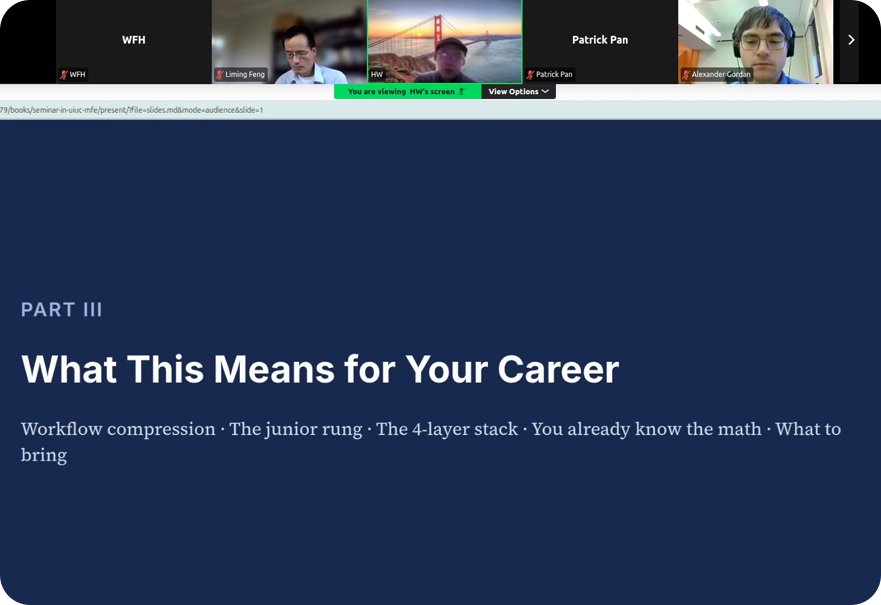
The third part was about careers.
On one slide I quoted my own book. In Above The Clouds I wrote about a time we tested a system that could do about seventy percent of a development workload. The team cheered.
Not long after, the company stopped hiring junior programmers.
I paused on that slide.
For students, the risk isn't that experienced quants disappear. It's that the bottom rungs, where experience used to get built, are the first to be automated.
So don't compete with the machine at what it does well.
What will be worth something is not how fast you write code. It's whether you can think a problem through, and whether you can tell at a glance when a result is wrong.
There was also a slide with two overlapping circles, the math of financial engineering and the math of AI, which overlap far more than most people expect. I wrote a separate entry about that the day before, so I won't repeat it here.
Questions
The chat had piled up more than a dozen messages.
One student asked how a model can keep up when the market never stops changing. That was the student with the Golden Gate background.
Others asked how what they learn in class connects to today's AI, and how to show an interviewer that you understand both finance and AI.
My answer, roughly: pick one product and understand it deeply. Build one project end to end that someone else can rerun. Never report a single run.
At the end I shared links to a few books I've written; math4ai.org is one of them.
Prof. Feng's Note
After I logged off, Prof. Feng wrote to say the talk had come at the right time, and had helped with some of the questions and uncertainties students have about AI and where quantitative finance is heading.
Uncertainties. I kept coming back to that word.
From 2012 to 2016 I did my MFE while working full time. Code by day, derivations at night, problem sets on weekends. I spent a lot of evenings staring at a page of equations, unsure how any of it connected to a real market.
No one told me.
I connected it myself, slowly, one job and one model at a time.
More than a decade later, through a screen, I got to talk to people sitting where I used to sit.
Not everything I said will turn out to be right. But what I wanted to hear back then, I finally got to say.
Closing
The slide I closed on read:
Mathematics tells you why it works.
AI tells you what can be learned from data.
Engineering determines whether it works in the real world.
The tools keep changing. A field that teaches you to price uncertainty won't be the first to go stale in a world full of uncertain models.
Slides from the talk: AI in Quantitative Finance (PDF)